

『E&h Flow Meter Calibration Frequency: How Often Should You Recalibrate?』Related information(clamp on meter|electromagnetic meter|venturi meterrotameter|orifice meter|ultrasonic flow meter|mass flow meter|coriolis mass flow meter|coriolis flow meter|magnetic flow meter|magmeter flow meter|magflow flow meter|mag meter flow meter|electromagnetic flow meter|vortex flow meter|turbine flow meter|thermal mass flow meter|thermal flow meter|rotameter flow meter)
E&H Flow Meter Calibration Frequency: How Often Should You Recalibrate?
Quick Answer
Recalibrate most E&H flow meters every 12 months for clean liquid or gas service. Reduce the interval to 6 months or less for custody transfer, viscous fluids, solids, gas bubbles, temperatures above 85 °C, or coatings. Always compare drift against your own plant data before you extend any cycle.
Why Calibration Frequency Is Not the Same for Every Plant
E&H flow meters ship with a factory calibration certificate. That document gives a starting point. It does not tell you how long the meter will stay within specification at your site. A Promag on clean water at 25 °C can hold 0.2% deviation for 24 months. A Promass on a hot resin line at 120 °C can shift 0.8% in 9 months.
Most engineers skip this part. They copy the vendor default and move on. We have seen this on customer sites many times. The correct interval depends on fluid type, pipe size, velocity, temperature, pressure, and the cost of a bad measurement.
How Often Should You Recalibrate an E&H Flow Meter?
Start with these practical intervals for standard process conditions.
Clean water, chilled water, or non-critical liquids. Recalibrate every 18 to 24 months. Check the 4-20 mA HART output at the same time.
Coriolis mass flow on oil, diesel, or LPG custody transfer. Recalibrate every 6 to 12 months. Many terminals and depots follow this schedule because a 0.3% drift on 500 m3/day is real money.
Electromagnetic flow meter on wastewater with solids or fat. Recalibrate every 6 to 12 months. Electrode coating can cause a negative deviation of 2% to 5% before the transmitter shows a fault. Many electromagnetic meters need fluid conductivity above 20 µS/cm for stable readings.
Chemical dosing with acids or caustic at temperature above 85 °C on a DN15 line. Recalibrate every 6 months. PT100 temperature compensation drift also affects mass or concentration calculations.
Vortex or thermal mass flow meter on saturated steam or gas. Recalibrate every 12 months unless the gas has moisture or dust. Then reduce to 6 months. For an ATEX Zone 1 gas line, calibration records are often mandatory.
What Shortens the Calibration Interval on an E&H Meter?
Process conditions matter more than age. We have seen a magnetic flow meter drift less than 0.1% in 5 years on clean water. The same model drifted 4% in 8 months on a sludge line.
High viscosity above 100 cP changes the flow profile inside the tube. Gas bubbles affect the signal on ultrasonic and Coriolis designs. Solids can erode electrodes and liners. Coating changes the cross section and can reduce flow reading.
A paint manufacturer in Southeast Asia used a Coriolis meter on a resin line at 80 °C. After 10 months, coating shifted density output
Calibration Check Without Removing the Meter
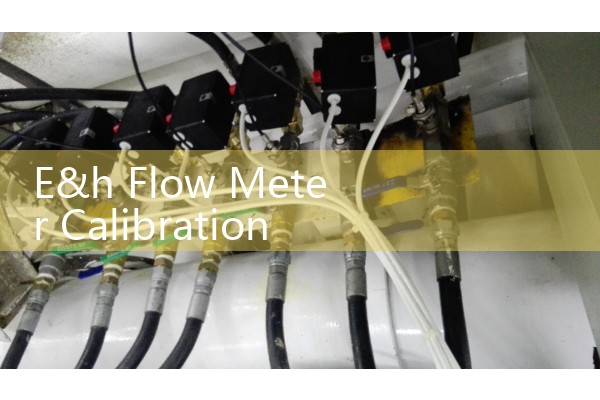
In many cases you can verify an E&H flow meter in situ. Use a clamp-on ultrasonic flow meter as a reference if the pipe is full and the wall is not lined. You can also test the 4-20 mA HART output with a loop calibrator to rule out transmitter drift.
For custody transfer or safety loops, a full bench calibration is better. The sensor and transmitter should be calibrated as one system. A master meter or weight tank gives the lowest uncertainty.
When Replacement Makes More Sense Than Recalibration
Recalibration cannot fix a damaged liner, a shorted electrode, or a drive coil on a Coriolis meter. If the zero point is unstable after cleaning and two calibrations, replacement is usually faster and cheaper.
Silver Automation Instruments supplies Coriolis mass flow meters, electromagnetic flow meters, ultrasonic flow meters, vortex flow meters, oval gear flow meters, thermal mass flow meters, pressure transmitters, and paperless recorders. Many customers replace older E&H Promag or Promass lines with our instruments when repair lead time is too long.
Calibration Service and CTA
We support plants in Southeast Asia, Australia, the Middle East, Latin America, and Africa. Send us the fluid type, pressure in bar, temperature in °C, pipe size DN, flow range in kg/h or m3/h, and output type. We will reply with a calibration plan or a replacement quote.
Call Silver Automation Instruments at +86-25-68650347. WhatsApp +86-25-52155837. WeChat +86 15365082610.
FAQ: Five Key Questions
How often should E&H flow meters be calibrated? For clean liquid service, 12 to 24 months. For custody transfer, high temperature, solids, or coating service, 6 to 12 months or less.
Can I extend the calibration interval if the meter looks stable? Yes, but only after three or more consecutive calibration checks show drift below 0.2% of rate. Keep the records in your maintenance system.
What is the first sign an E&H flow meter needs recalibration? A trending shift in totalized volume against tank levels, an unstable zero, or a noisy 4-20 mA HART signal. These signs often appear before a hard alarm.
Do you calibrate E&H meters at Silver Instruments? Yes. We can check the transmitter, sensor, and output loop. We also supply replacement meters if the sensor is beyond repair.
Which flow meter needs more frequent calibration, Coriolis or electromagnetic? It depends on the fluid. Coriolis meters need more attention on viscous or coating fluids. Electromagnetic meters need more attention on low conductivity or electrode coating applications.
 Hot Product
 Related AD