

『200 Ml/Min Flow Meter Viscosity Correction Factors』Related information(clamp on meter|electromagnetic meter|venturi meterrotameter|orifice meter|ultrasonic flow meter|mass flow meter|coriolis mass flow meter|coriolis flow meter|magnetic flow meter|magmeter flow meter|magflow flow meter|mag meter flow meter|electromagnetic flow meter|vortex flow meter|turbine flow meter|thermal mass flow meter|thermal flow meter|rotameter flow meter)
200 Ml/Min Flow Meter Viscosity Correction Factors
Quick Answer: For flow meters running at 200 ml/min, viscosity correction factors adjust the pulse constant or analog output when the process liquid is thicker than the factory calibration fluid (typically water). Silver Instruments delivers pre-calculated correction curves with every oval gear meter, so the totalized volume stays within ±0.5% even at 500 cP. Send us your fluid type, operating temperature, and pipe size to receive a personalized correction chart.
Why Viscosity Shifts Accuracy at Flow Rates Around 200 ml/min
At 200 ml/min the internal clearances inside a positive displacement meter become the dominant error source. In an oval gear meter, the gap between the gears and the chamber wall allows a small slip flow. With water (1 cP) this slip can steal 1 to 3% of the swept volume. As viscosity rises to 50 cP, the fluid film stiffens, slip drops, and more volume is captured per gear revolution. The raw K-factor (pulses per liter) increases. Here is the thing: at 200 ml/min the slip flow does not change in a straight line with viscosity. It drops sharply between 10 and 50 cP, then levels off. A factory water calibration hides this entire curve. Many engineers run a water calibration, switch to a 300-cP resin, and then wonder why the batch weight is off by 3 kg. We saw a similar issue at a paint plant in Thailand: a 300 cP alkyd resin at 200 ml/min read 12% low on a water-calibrated turbine meter. Most engineers skip this part, but the gap geometry matters just as much as the K-factor.
Correction Factor Definition and Calculation
The viscosity correction factor (VCF) is the ratio of the actual K-factor of the meter at process viscosity to the K-factor obtained during water calibration. VCF = K_visc / K_water. A VCF of 1.03 means the meter generates 3% more pulses per liter in the viscous fluid. To correct a totalizer, multiply the accumulated pulses by (1 / VCF). For an analog 4-20 mA output, scale the span accordingly. Silver Instruments factory calibration sheets include a five-point viscosity vs. frequency table measured at 20, 40, and 60 °C. Typical shift at 200 ml/min for a DN4 oval gear meter moving from 1 cP to 200 cP is a VCF between 1.015 and 1.045, depending on gear material and clearances.
Silver Instruments Flow Meters for 200 ml/min with Viscosity Correction
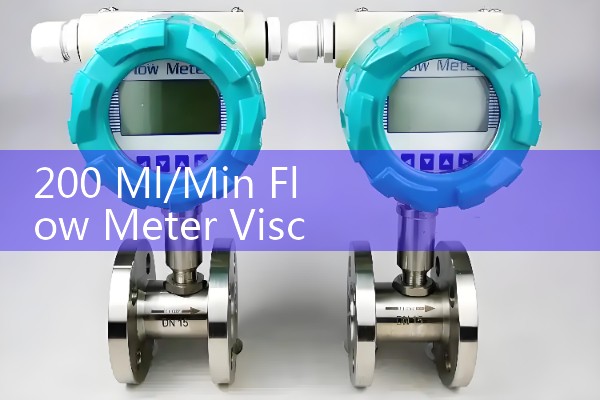
The OGF-A miniature oval gear flow meter series is purpose-built for low-flow dosing. It covers 0.02 to 0.5 L/min (20 to 500 ml/min) with standard DN4 and DN6 connections, 316L stainless steel or aluminum wetted parts, and PTFE gears for aggressive chemicals. Each meter is tested at the factory with mineral reference oils at 1, 10, 100, 500, and 1000 cP. The supplied report lists the actual K-factor at each viscosity and a third-order polynomial so your PLC or batch controller can apply real-time correction. For conductive liquids, the MF2000 miniature electromagnetic flow meter offers an alternative without viscosity dependency, but it requires a minimum conductivity of 5 µS/cm.
Real-World Example: Silicone Oil Dosing in a Vietnam Factory
Last year a silicone sealant manufacturer in Ho Chi Minh City approached us. They needed to dose a 150-cP silicone oil at exactly 200 ml/min into a mixing chamber. Th
How to Use the Correction Factor On-Site
First, measure the true viscosity of your process fluid at the operating temperature. Use a portable viscometer or send a sample to a lab. Compare the value with the correction table supplied by Silver Instruments. If you use a pulse-output batch controller, replace the default K-factor with the viscosity-adjusted K-factor from the table. For Modbus or 4-20 mA systems, apply the VCF to the scaling parameters. Do not rely on a single number for all conditions. A paint additive at 25 °C may be 200 cP, but at 40 °C it can drop to 80 cP. Our correction reports often include three temperature points so you can create a simple look-up table. By spending ten minutes on this setup, many customers cut dosing errors from 5% down to 0.3%.
Frequently Asked Questions
Does a Coriolis mass flow meter need viscosity correction factors? No. Coriolis meters measure mass directly and are independent of viscosity changes. However, a micro Coriolis for 200 ml/min can cost five to ten times more than an oval gear meter with a correction chart. If your budget and accuracy target allow, the OGF-A plus correction data is often the smarter choice.
What is the maximum viscosity your correction factors can handle? Our standard calibration goes up to 100,000 cP using heavy oil references. For pastes or non-Newtonian fluids above that, we recommend sending a sample for a custom calibration run.
How often should I recheck the correction factor? For batch processes where the fluid grade changes, check the viscosity of every new drum. For continuous processes with a stable supply, an annual verification is sufficient. Silver Instruments can supply a re-calibration service if you return the meter.
Do temperature changes affect the correction factor? Yes, significantly. A 20 °C change can cut viscosity by half in many oils. Our standard data package includes K-factor curves at 20 °C, 40 °C, and 60 °C. Tell us your operating temperature range during ordering so we include the right points.
Can I get a custom correction chart for my specific blend? Absolutely. Ship 2 liters of your fluid to our calibration lab in China. We will run a viscosity sweep and email you a PDF report with the correction factors within five working days. This service costs USD 150, waived if you order a meter at the same time.
To request a viscosity correction factor chart for a 200 ml/min flow meter, email [email protected] and include your fluid name, viscosity in cP, temperature in °C, pipe size, and required flow range. Our engineers will reply with a personalized data sheet and a meter recommendation within 24 hours.
 Hot Product
 Related AD