
 About Us
Vortex Flow Sensors: Non-Moving-Part Karman Shedding Frequency Metrology Devices
Quick Answer: A vortex flow sensor measures liquid, gas, and steam flow. It uses a bluff body to generate Karman vortices. The vortex shedding frequency is proportional to flow velocity. No moving parts means lower maintenance in tough process lines.
How the Karman Shedding Frequency Works
Fluid passes a fixed bluff body. Vortices alternate from one side to the other. The shedding frequency is linear with flow velocity. The meter counts these pulses. The pulse count maps to flow volume.
This is the metrology part. The vortex frequency is a repeatable physical quantity. No moving parts touch the flow stream. The bluff body stays fixed. Only the vortices move.
Why Non-Moving-Part Design Matters in the Field
Most engineers skip this part. But the non-moving-part structure is the main reason vortex meters survive in steam, hot gas, and dirty liquid service. There is no rotor to wear. There is no bearing to jam. There is no gear to break.
We have seen this on customer sites many times. A replacement rotor meter in a steam line may fail in months. A vortex meter in the same line often runs for years. The upfront cost is similar. The maintenance cost is not.
Typical Outputs and Signal Handling
Silver Instruments supplies vortex flow sensors with 4-20 mA HART output. Some models include a pulse output for totalization. A digital display can show flow rate, total flow, and diagnostic data.
For steam mass flow, an integrated PT100 temperature sensor is common. The transmitter calculates density compensation. You get a direct mass flow output in kg/h. For saturated steam, this is a practical solution.
ATEX Zone 1 certification is available for gas and chemical plants. The meter body can be stainless steel. Process connections are usually wafer type or flanged. Line sizes run from DN15 to DN300.
Applications We See Across Southeast Asia, the Middle East, and Latin America
Vortex flow meters are common in utility steam lines. A beverage plant in Vietnam may use a DN50 vortex meter to measure clean steam. A chemical site in Saudi Arabia may use a DN80 meter on a solvent transfer line. A water treatment plant in Chile may use a DN100 meter on compressed air.
Because the vortex meter handles a wide temperature range, it fits process steam, hot water, and thermal oil. But the fluid must have a minimum Reynolds number. Very low flow can drop below the measurable range.
Last year a customer in Vietnam asked us for a steam flow meter for a 6 bar saturated steam header. We supplied a DN65 vortex meter with integrated PT100 and a 4-20 mA HART output. The site team installed it between two flanges and had a live reading the same day.
Sizing Notes for Engineers and Buyers
Send us the pipe size, fluid type, pressure, temperature, minimum flow, and normal flow. For gas and steam, include pressure in bar and temperature in degrees Celsius. For liquids, include density or viscosity if it is outside water-like range.
Velocity range matters. Most vortex meters need a pipe velocity from about 0.3 m/s to 10 m/s for liquids. Gas and steam can go higher. If the line is oversized, the meter may not measure low flow. If the line is undersized, pressure drop increases.
For a DN40 steam line at 10 bar saturated steam, a vortex meter with temperature compensation is a standard choice. For a DN25 water line with flow from 0.5 m/s to 4 m/s, a basic liquid vortex meter with pulse output works well.
Silver Instruments Vortex Meter Range
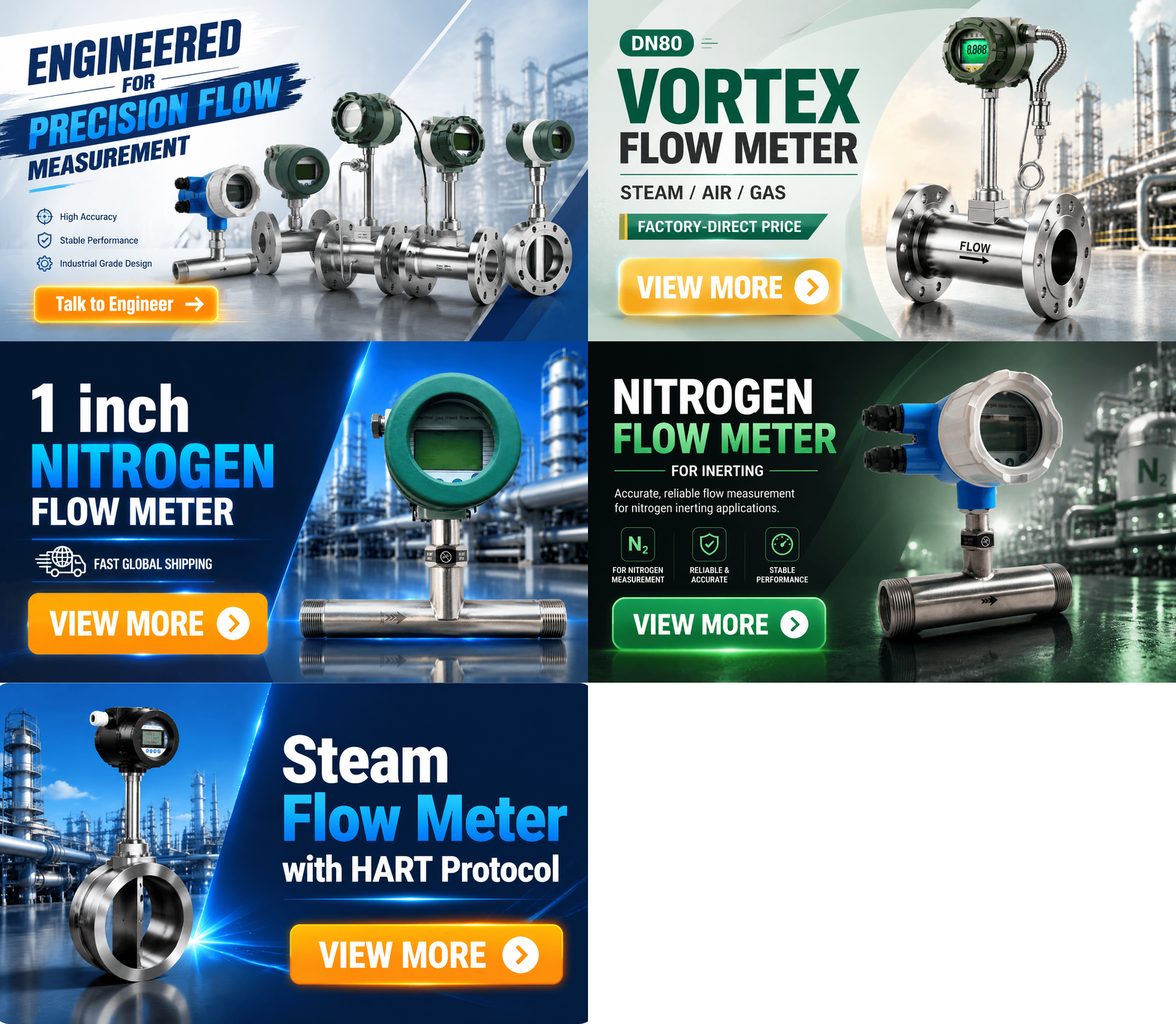
Silver Automation Instruments offers inline vortex flow sensors for liquid, gas, and steam. Process connections include wafer, flange, and insertion styles. Line sizes cover DN15 to DN300. Wetted materials include 304 stainless steel and 316 stainless steel.
The electronics support 4-20 mA HART, RS485 Modbus, and pulse output. Local display is optional. Ex approvals include ATEX Zone 1 and Zone 2. Ingress protection is usually IP65 or IP67.
FAQ
Can a vortex flow meter handle saturated steam?
Yes. Saturated steam measurement is one of the most common uses. Include pressure and temperature data. Select a meter with integrated PT100 or external pressure compensation. The output can be kg/h or t/h.
Does a vortex flow sensor work on low viscosity liquids?
Yes. Water, diesel, condensate, and many solvents are measurable. Very high viscosity fluids above about 30 cP may damp the vortex shedding. In those cases, an oval gear meter or Coriolis meter is often a better fit.
What is the typical accuracy of a vortex flow meter?
For liquids, accuracy is often plus or minus 1 percent of reading. For gas and steam, accuracy is often plus or minus 1.5 percent of reading. Repeatability is better at around plus or minus 0.3 percent. Calibration conditions affect these values.
Can I use a vortex meter on compressed air?
Yes. Compressed air lines from DN25 to DN100 are common. You need the line pressure and temperature for mass flow compensation. A pulse output can drive a totalizer for plant air consumption monitoring.
What information do I need to send for a quote?
Send us your fluid type, pipe size in DN, flow range, pressure in bar, temperature in degrees Celsius, and output requirement. For steam, also note saturated or superheated. We will recommend a meter body size, connection type, and transmitter option.
Contact Silver Automation Instruments
For a vortex flow meter quote, contact Silver Automation Instruments. Tel: +86-25-68650347. Whatsapp: +86-25-52155837. WeChat: +86 15365082610. Send your pipe size, fluid type, pressure, temperature, and flow range. We will reply with a model and price.
 Product List
 Contact Us
 Related AD