

『Fci Thermal Dispersion Flow Meter Operating Principle: Direct Mass Flow Testing Without Moving Parts』Related information(clamp on meter|electromagnetic meter|venturi meterrotameter|orifice meter|ultrasonic flow meter|mass flow meter|coriolis mass flow meter|coriolis flow meter|magnetic flow meter|magmeter flow meter|magflow flow meter|mag meter flow meter|electromagnetic flow meter|vortex flow meter|turbine flow meter|thermal mass flow meter|thermal flow meter|rotameter flow meter)
FCI Thermal Dispersion Flow Meter Operating Principle: Direct Mass Flow Testing Without Moving Parts
Quick Answer: A thermal dispersion flow meter measures gas mass flow directly. It uses two temperature sensors and no moving parts. FCI thermal dispersion flow meters and Silver Automation Instruments thermal mass flow meters both apply this principle for air, natural gas, biogas, and stack gas measurement.
How the FCI Thermal Dispersion Operating Principle Works
An FCI thermal dispersion flow meter has two platinum RTD sensors in contact with the gas stream. One sensor measures the gas temperature. The other sensor is heated by the electronics. The control circuit holds a constant temperature difference between the heated sensor and the reference sensor. Gas flowing past the heated sensor removes heat. More mass flow removes more heat. The electronics measure the additional power required to hold the temperature difference constant. That signal becomes a mass flow output in kg/h or Nm3/h.
The measurement is direct because the heat transfer depends on the number of gas molecules hitting the sensor. It does not require a separate pressure transmitter or temperature transmitter to calculate mass flow. This is why FCI calls it direct mass flow testing. Silver Automation Instruments uses the same physical principle in its thermal mass flow meter range. A PT100 element is common. Some designs use a heated resistance sensor and an unheated reference sensor.
Why No Moving Parts Improves Field Reliability
Thermal dispersion flow meters have no rotating gears, no turbine blades, and no bearings in the flow path. This matters in dirty gas, wet gas, or high vibration installations. A vortex meter has a bluff body and a sensor that can vibrate. An oval gear meter has moving parts. A thermal meter only has two welded sensor probes. In practice, a wastewater plant in Australia may use thermal mass flow meters in aeration air lines. A cement plant in the Middle East may use insertion thermal probes in a dirty flue gas duct. Both installations avoid bearing wear and mechanical failure.
Because there are no moving parts, maintenance is mostly sensor cleaning and occasional calibration. This is the main reason FCI thermal dispersion flow meters are used in harsh gas service. Silver Automation Instruments supplies similar insertion and inline thermal mass meters for plant air, digester gas, and flue gas. For compressed air, the sensor can be installed through a ball valve with a hot tap. That means the meter can be removed without shutting down the air line. In many plants this is a deciding factor.
Direct Mass Flow Testing in Real Conditions
Gas density changes with pressure and temperature. A volumetric flow meter such as a turbine meter or vortex meter needs density compensation to output mass flow. Thermal dispersion meters do not need this. The output is already mass flow because the sensor responds to the cooling effect of gas molecules. A compressor station in Nigeria measuring air at 7 bar and 30 °C gets a direct kg/h reading. A food processor in Vietnam measuring oven exhaust at 180 °C gets a direct Nm3/h reading after setting the gas composition in the electronics.
Here is the thing. Most engineers skip the linearization step on site. The factory sets the gas type, pipe diameter, and flow range. The meter outputs 4-20 mA HART or RS485 Modbus. A thermal meter is easier to install than many compensated flow systems. It is not a device for liquid flow. It is for gas. For liquid mass flow, Silver Automation Instruments offers Coriolis mass flow meters and oval gear flow meters.
FCI Thermal Dispersion Meter Models and Comparable Silver Instruments Options
FCI ST100 series thermal mass flow meters cover air, natural gas, and process gas
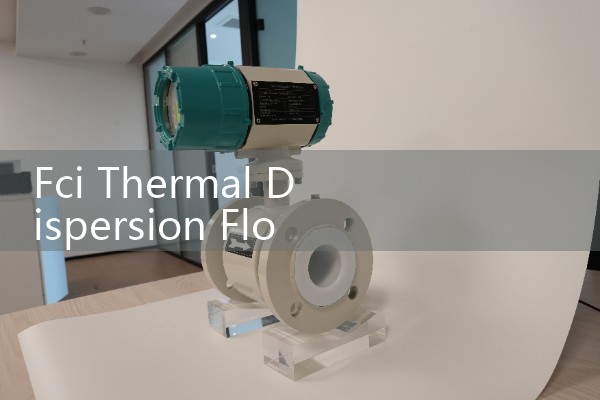
Typical flow velocity range is 0.5 to 100 m/s for air at standard conditions. The actual flow range depends on gas composition, pipe size, and process temperature. A Silver Automation Instruments thermal mass meter for compressed air at DN50 and 7 bar might cover 10 to 2000 kg/h. The same meter style for biogas at 0.3 bar and 40 °C may cover a lower range. That is why the factory asks for gas type, pressure, temperature, pipe size, and flow range. This is not a single range product.
Installation Tips That Affect Accuracy
Thermal dispersion meters need a straight run of pipe. For most installations, use 15D upstream and 10D downstream. Avoid mounting the sensor after a control valve or elbow if possible. In dirty gas, install the insertion probe at a slight angle or use a blow-down port. Condensation causes error. For wet biogas, install a condensate trap and slope the pipe away from the meter. If the gas contains water droplets, the sensor will read high because water carries more heat than gas. A separator upstream fixes this.
We have seen this on customer sites many times. A biogas plant in Thailand had unstable readings because the meter was installed too close to a bend. They moved the probe to a straight run and the output stabilized. In another case, a paint manufacturer in Southeast Asia measured oven exhaust gas with an insertion probe in a 600 mm stack. The probe had no moving parts to wear. The main issue was resin buildup on the sensor. Cleaning every two months solved it.
Frequently Asked Questions
What gases can a thermal dispersion flow meter measure?
Air, nitrogen, oxygen, natural gas, biogas, digester gas, stack gas, and carbon dioxide are common. The meter must be calibrated or set for the correct gas composition. For mixed gases, provide the gas mix to Silver Automation Instruments before ordering.
Can a thermal dispersion flow meter measure liquid flow?
No. Thermal dispersion is for gas mass flow. For liquid, use a Coriolis mass flow meter, electromagnetic flow meter, or oval gear flow meter from Silver Automation Instruments.
What is the typical turndown ratio for thermal dispersion meters?
Many industrial thermal dispersion meters offer 100:1 turndown. FCI and Silver Instruments designs can read low flow velocities down to about 0.5 m/s. Actual range depends on gas composition, pipe size, and installation.
Does the FCI thermal dispersion principle work with wet gas or saturated air?
Wet gas can cause measurement error because water droplets carry more heat away. You need a moisture separator or a model rated for wet gas. For saturated biogas, install a condensate trap upstream and slope the pipe away from the meter.
What approval do I need for natural gas or biogas?
Specify the hazardous area zone clearly. For most natural gas pipe runs, ATEX Zone 1 or Zone 2 is required. Silver Automation Instruments supplies thermal mass flow meters with Ex d or Ex ia approvals and 4-20 mA HART output.
Send your gas type, pressure in bar, temperature in °C, pipe size DN, and flow range in kg/h or Nm3/h to Silver Automation Instruments. Tel: +86-25-68650347. Whatsapp: +86-25-52155837. WeChat: +86 15365082610. For product specifications, visit flow-meter.com.au.
 Hot Blog
 Related AD