

 Current position > News detail
『Accuracy Of Micro Flow Meter At Low Flow Rate Variations』Related information(clamp on meter|electromagnetic meter|venturi meterrotameter|orifice meter|ultrasonic flow meter|mass flow meter|coriolis mass flow meter|coriolis flow meter|magnetic flow meter|magmeter flow meter|magflow flow meter|mag meter flow meter|electromagnetic flow meter|vortex flow meter|turbine flow meter|thermal mass flow meter|thermal flow meter|rotameter flow meter)
Accuracy Of Micro Flow Meter At Low Flow Rate Variations
Quick Answer: Micro flow meters that use Coriolis or thermal mass sensing principles hold accuracy better than 0.5% of reading even when flow drops from 10 L/h down to 0.1 L/h. Oval gear meters also perform well with viscous fluids but require a minimum backpressure. In practice, most accuracy problems at low flow do not come from the sensor itself. They come from installation effects, gas bubbles, or pulsating flow that the spec sheet cannot predict.
Why Low Flow Accuracy Falls Apart in the Field
Many engineers read a data sheet and see accuracy of 0.2% under reference conditions. Then they install the meter in a DN4 line with fluctuating backpressure and the reading drifts by 3% or more. We see this on customer sites in Indonesia, Thailand, and Saudi Arabia repeatedly. A chemical dosing skid that targets 0.5 L/h of additive cannot afford 3% uncertainty. The process recipe goes out of spec fast.
Real low flow conditions are rarely stable. A small gear pump produces pulses. A syringe pump ramps up and down. A peristaltic pump squeezes fluid in discrete slugs. These mechanical cycles confuse meters that rely on steady velocity profiles. Vortex meters lose the shedding frequency below a Reynolds number of about 4000. Electromagnetic meters need a minimum flow velocity around 0.2 m/s to stay within stated accuracy. Below that, signal noise overtakes the true flow signal.
Temperature shifts also hit micro flow meters hard. A thermal mass meter compensates for gas temperature, but liquid thermal mass meters react to the specific heat capacity of the fluid. A 2°C drift in a 0.2 mm capillary changes viscosity enough to shift the laminar flow profile. Honey, silicone oil, and heavy fuel oil customers in the Middle East often send us their viscosity curves before we recommend a meter. Without that detail, accuracy claims are just paper numbers.
Coriolis Meters Hold Accuracy Down to Near Zero Flow
Coriolis mass flow meters measure mass directly by detecting the phase shift in vibrating tubes. Because the measurement principle is independent of flow profile, the accuracy stays flat across a wide turndown ratio. We supply mini Coriolis meters with tube sizes as small as DN1. At a setpoint of 0.2 kg/h for liquid methanol, a Coriolis meter from Silver Instruments can hold ±0.2% of reading with repeatability better than 0.05%.
Here is a real scenario. A cosmetic manufacturer in Vietnam doses fragrances into a blending tank. The flow rate varies from 0.05 L/h during the initial trial recipe to 2 L/h during full production. A magnetic flow meter fails below 0.5 L/h because the signal is too weak. An oval gear meter adds pressure drop that the peristaltic pump cannot overcome. The Coriolis meter handles the entire range because the sensor tubes oscillate at their natural frequency regardless of flow rate. The transmitter just reads the phase difference. No custom calibration is needed between batches.
Coriolis meters also cancel out the effect of air bubbles better than other technologies. At micro flow, a 0.01 mL bubble occupies a large fraction of the measuring tube volume and can cause a positive or negative spike. A Coriolis meter operating at a high drive frequency can often push through the bubble without losing the mass flow calculation. We have tested this with water and ethanol mixtures on our bench in Nanjing. The bubble-induced error stays within 0.5% as long as gas void fraction remains under 2% by volume.
Thermal Mass Meters for Clean Gas at mL/min Rates
For gas micro flow, thermal mass flow meters are often the best choice. A thermal sensor heats a capillary tube and measures the temperature distribution. As flow increases, the temperature profile shifts downstre am. The sensor does not care about pressure or temperature fluctuations if the meter includes a built-in density compensator. Silver Instruments thermal meters for gases cover ranges from 0.5 mL/min to 30 L/min with an accuracy of ±1% of reading plus 0.2% full scale.
We supplied thermal meters to a biogas research lab in Australia that needed to measure methane flow at 10 mL/min from small anaerobic digesters. The gas saturated with water vapor caused corrosion issues with mechanical meters. The thermal meter sensor made of 316L stainless steel with a glass coating survived two years without drift. The customer checked calibration every six months with a DryCal calibrator and found the deviation stayed within 0.8% of reading.
Low flow gas measurement in laboratory conditions requires the meter to ignore ambient temperature swings. A lab in Singapore had air conditioning cycling between 22°C and 25°C. The thermal mass meter with a remote electronics head mounted in a stable environment solved the zero drift problem. We recommend putting the sensor in the process line and keeping the transmitter away from heat sources, fans, or direct sunlight.
Oval Gear Meters and Viscous Fluids Below 1 L/h
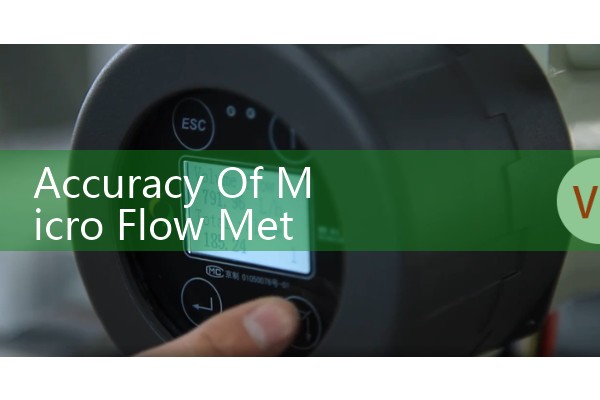
Oval gear positive displacement meter
Seawater and low-viscosity fluids like acetone cause high slip in oval gear meters unless the meter is sized with tight clearances. A desalination plant in Oman needed to dose antiscalant at 0.7 L/h with a target accuracy of 2%. A standard oval gear meter with graphite internals wore down after four months. Silver Instruments supplied a meter with PEEK gears and ceramic bearings. Regular flush with fresh water once a week extended the service interval to 18 months.
Installation Factors That Destroy Micro Flow Accuracy
Pipe vibration is the silent killer of low flow measurement. A Coriolis sensor mounted on a thin bracket picks up pump vibration at 50 Hz. The control room sees a flow signal bouncing between 0.02 and 0.15 L/h when the actual flow is steady at 0.08 L/h. We always advise rigid pipe supports, flexible hoses before and after the meter, and separation from vibrating equipment. A simple rubber grommet under the bracket often reduces noise by an order of magnitude.
Gas bubbles in liquid lines cause more calls to our support team than any other issue. A dosing pump that runs dry for a few seconds introduces a gas pocket. The next stroke pushes the bubble through the meter. An electromagnetic meter reads a sudden spike. A Coriolis meter shows density dropping below the liquid value. The fix is not a better meter. It is a bubble trap or a back-pressure valve set to at least 0.5 bar above the vapor pressure of the fluid. A food factory in the Philippines making fruit syrup installed a simple sight glass and a manual vent before the Coriolis meter. The batch accuracy improved from ±8% to ±0.3% immediately.
Pulsating flow from small piston or diaphragm pumps creates a measurement challenge at frequencies below 5 Hz. A thermal mass meter with slow response time averages the pulses and gives a mean value that often reads 10 to 15% low. A Coriolis meter with a fast 10 ms update rate can track each pulse and calculate the true accumulated mass. We tested this with a metering pump running at 1 Hz and the Coriolis totalizer matched the gravimetric scale within 0.15 g over 100 g total.
FAQ
What is the smallest flow rate a Coriolis micro flow meter can measure accurately?
A DN1 Coriolis meter from Silver Instruments can measure down to 0.02 kg/h with an accuracy of ±0.5% of reading for water-like liquids. The true minimum depends on fluid density. Heavier fluids produce stronger Coriolis force and improve the signal-to-noise ratio.
Do thermal mass flow meters work for liquid micro flows?
Yes, but only for clean, non-coating liquids with known heat capacity. Thermal liquid meters handle ranges from 0.05 mL/min to 100 mL/min. They need a stable inlet temperature. A 0.1°C drift causes noticeable zero offset, so insulation and a heat sink are often required.
Why does my oval gear meter lose accuracy when the flow rate changes quickly?
Oval gear meters rely on a small pressure drop to turn the gears. Rapid flow changes create acceleration effects that alter the pressure field across the gears. The slip flow increases momentarily and then stabilizes. A fast totalizing counter helps, but for pulsating or ramp flows a Coriolis meter will be more robust.
How can I test the accuracy of a micro flow meter on site?
Gravimetric testing with a high-resolution balance is the most practical method. Weigh the collected fluid over a timed interval. The balance resolution should be at least 0.001 g for flows under 0.1 L/h. A repeatable pump, a beaker on a balance, and a stopwatch give a combined uncertainty under 0.2% if you control evaporation and vibration.
Which micro flow meter handles dirty fluids with particles at low flow rates?
A positive displacement oval gear meter with hard-coated rotors can pass particles up to 50 µm without jamming. Coriolis meters with straight tubes have no obstacles but can erode if particles are sharp and hard. For abrasive slurries at very low flow rates, we sometimes suggest a flow conditioner ahead of a thermal mass meter if the fluid is aqueous and the solids loading is below 5%.
Send us your minimum and maximum flow rate, fluid name, viscosity at operating temperature, pipe connection size, and pressure drop budget. Our engineers will propose a meter and share test reports from similar applications. Request a quote at Silver Automation Instruments or email directly through our website flow-meter.com.au. Specify whether you need ATEX Zone 1 certification, 4-20 mA HART output, or Modbus RTU communication.