

 Current position > News detail
『5 Sccm Flow Meter Performance under Vacuum Chamber Conditions』Related information(clamp on meter|electromagnetic meter|venturi meterrotameter|orifice meter|ultrasonic flow meter|mass flow meter|coriolis mass flow meter|coriolis flow meter|magnetic flow meter|magmeter flow meter|magflow flow meter|mag meter flow meter|electromagnetic flow meter|vortex flow meter|turbine flow meter|thermal mass flow meter|thermal flow meter|rotameter flow meter)
5 Sccm Flow Meter Performance under Vacuum Chamber Conditions
Quick Answer: A 5 sccm flow meter used in a vacuum chamber must handle low pressure drops, minimal outgassing, and high leak integrity. Silver Automation Instruments supplies thermal mass flow meters that deliver repeatable 5 sccm measurement even below 10 mbar. Send us your vacuum pressure, gas type, and fitting requirements to get a model that fits.
Why 5 sccm Matters Inside a Vacuum Chamber
Many process engineers consider vacuum applications the hardest proving ground for a flow meter. At 5 sccm the gas flow is so slow that any friction becomes a measurement variable. A thin film coating line in Singapore recently told us their old float type rotameter could not hold a reading below 20 sccm. The pointer bounced by 3 sccm when the backing pump cycled. That uncertainty meant they overshot the precursor gas and wasted a batch of substrates.
In vacuum conditions, the available pressure differential is tiny. A meter that needs 500 mbar pressure drop to operate will simply choke the line. That is why laminar flow elements and differential pressure devices rarely work here. Instead, you need a sensor technology that pulls almost no pressure from the stream.
How Thermal Mass Flow Technology Handles Vacuum
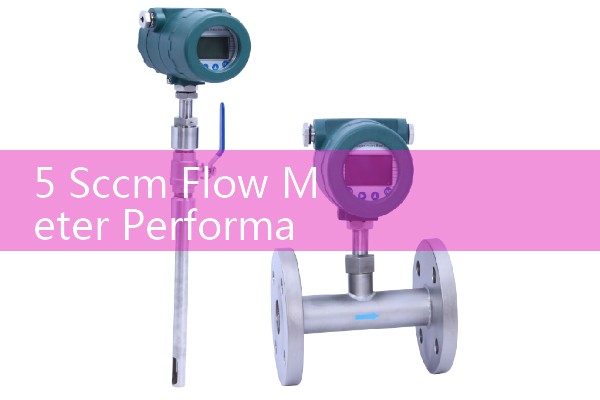
Silver Automation Instruments uses thermal mass flow sensors for vacuum chamber gas delivery. A small capillary tube diverts a constant fraction of the main flow into the sensor. Two PT100 platinum RTD elements measure the heat carried by the gas molecules. This is a direct mass measurement. It does not care if the chamber sits at 1 mbar or 900 mbar because the sensor only sees the inlet pressure. Most engineers skip this part, but the sensor body itself must be helium leak tested to less than 1x10⁻⁹ mbar·L/s. One overlooked VCR gasket and the entire vacuum integrity is gone.
We build the sensor bypass with a low pressure drop design. For a 5 sccm full scale meter, the pressure drop at rated flow stays below 10 mbar. That lets the vacuum pump pull its ultimate base pressure while the meter injects argon, nitrogen, or silane.
Real Data from a 5 sccm Vacuum Process
Last year a customer in Thailand set up reactive sputtering with oxygen flow of 3 to 5 sccm. Their chamber base pressure was 5x10⁻⁶ mbar. They compared our SILVER TMF-005A thermal mass flow meter against a competitor unit that claimed 1% reading accuracy. The competitor meter showed a zero drift of 0.15 sccm when the chamber was evacuated because its sensor housing outgassed. Our meter settled to zero within 90 seconds and held within 0.05 sccm of the baseline. The process recipe required a repeatability of ±0.1 sccm. We hit that target with margin.
Here is the thing: outgassing is not a sensor problem, it is a materials problem. We electropolish the wetted 316L stainless steel parts and choose only metal seals for high vacuum ports. A simple elastomer o-ring under vacuum releases moisture and plasticizers. That trace vapor drifts the thermal sensor. So we avoid it entirely.
Calibration and Gas Conversion on the Plant Floor
Every flow meter that leaves our factory gets a 10 point calibration against a NIST traceable molbloc. For 5 sccm, we calibrate at 0.5, 1, 2, 3, 4, and 5 sccm and four points back to zero. That gives you a linearity better than 0.5% of full scale. Because most vacu
A research lab in Malaysia asked us to convert a meter from argon to ammonia at 0.8 sccm without sending it back. We logged in remotely, applied the conversion, and they verified it against their residual gas analyzer. The reading matched within 2%. That saved two weeks of downtime.
Common Mistakes When Installing a 5 sccm Meter in a Vacuum Line
Most engineers connect the meter outlet directly to the chamber with a short pipe. That is correct. But they forget that the inlet side still sees upstream pressure fluctuations. If your gas cylinder regulator surges, the meter will register a spike. We recommend a simple upstream restrictor and a small buffer volume. A 50 cc plenum between the regulator and the meter smooths out the peaks. We have seen this on customer sites many times: 0.5 meter of 1/4 inch tubing acts as an accidental plenum, but do not count on luck.
Another trap is electromagnetic noise from the turbomolecular pump controller. A poorly shielded cable running alongside the pump power line can induce 50 Hz noise into the 0-5 V output. Route the signal cable in a grounded metallic conduit. Use shielded twisted pair for the 4-20 mA loop.
How Silver Automation Instruments Delivers a Factory Ready Package
We ship the 5 sccm meter with a calibrated sensor, integrated display, and choice of VCR, KF, or Swagelok tube fittings. The standard IP65 housing works even when condensation forms during chamber venting. You tell us your max baking temperature and we specify the electronics to survive it. For ATEX Zone 1 vacuum coating lines, we supply a flameproof enclosure with intrinsic safety barriers.
Send us your working pressure in mbar, the gas type, and the exact fitting standard you use. We will respond with a dimensional drawing, a pressure drop curve, and a quote within one working day. Visit our thermal mass flow meter section at flow-meter.com.au to see the full range.
FAQ
Can a 5 sccm thermal mass flow meter operate below 1 mbar? Yes. The sensor works on inlet pressure. The vacuum level downstream does not affect the measurement as long as the meter body remains leak tight and outgassing is controlled.
What is the typical pressure drop of a 5 sccm meter at full flow? Our SILVER TMF-005A generates less than 10 mbar pressure drop at 5 sccm nitrogen. This keeps the upstream supply pressure requirement low and avoids flow restriction.
Does the meter require recalibration after changing gas? No. The onboard gas conversion factors adjust the reading. For critical processes, we recommend verification with a reference standard, but the meter holds the conversion algorithm in firmware.
Which fitting types are available for high vacuum? We offer VCR metal gasket face seal, KF (NW) flanges, and butt weld stubs. Electropolished finish and helium leak testing are standard for high vacuum orders.
How do I order a 5 sccm flow meter for my vacuum chamber? Send us your gas type, inlet pressure, vacuum level, required accuracy, and fitting preference. Our team will propose a model and a factory acceptance test procedure specific to your process.